FEMA’s declarations database lists 26 federal disaster declarations that include Monroe County, Mississippi, from March 1973 through February 2026. Six of them carry a hurricane’s name: Ivan, Dennis, Katrina, Gustav, and Ida twice. Aberdeen is about 250 road miles from the Gulf of Mexico. That is the odd fact in the record, and it is less about wind than about how declarations work.
What the list actually contains
We pulled every declaration with Monroe County as a designated area from the OpenFEMA Disaster Declarations Summaries dataset. Twenty-one are major disaster declarations, the kind that can open individual assistance to households. Five are emergency declarations, which mostly fund the county’s own response costs.
By incident type, the 26 break down like this: 14 for severe storms, tornadoes, straight-line wind, or flooding; 6 hurricanes; 4 for winter weather (a 1977 freeze, the January 1999 ice storm, and an emergency and a major declaration for the winter storm this past January and February); and 2 for COVID-19.
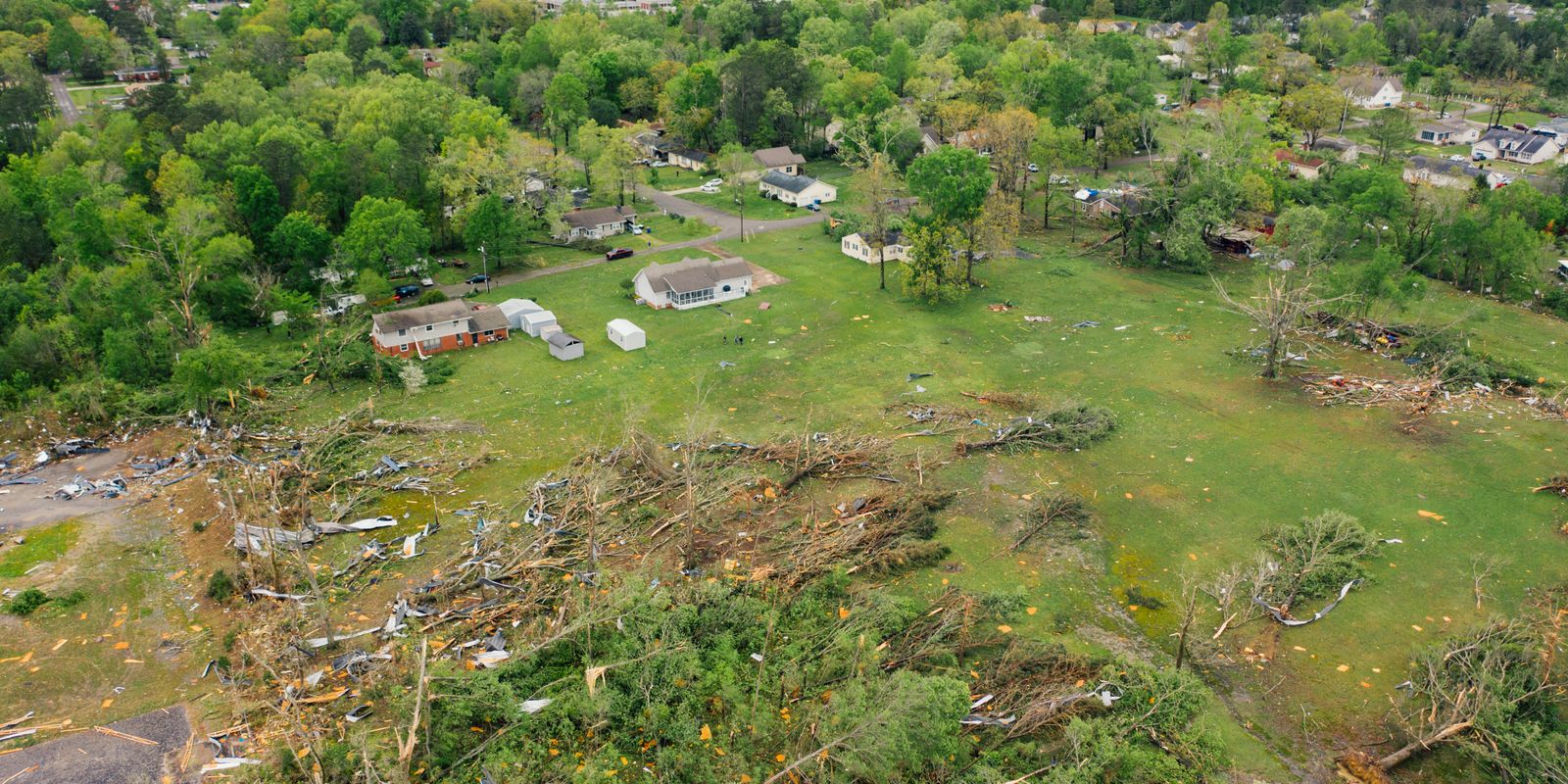
The severe-storm count is the one that matters to a house between Amory and Hamilton. Those 14 declarations run from 1973 through March 2023, and the gaps between them have been getting shorter. Between 1973 and 1999 there were five. Between 2010 and 2023 there were six.
Why an inland county collects hurricane declarations
A federal declaration is a funding decision. When Katrina came ashore in August 2005, the major disaster declaration covered a long list of Mississippi counties well north of the coast, because the storm was still producing damaging wind and power outages hours inland and because northern counties were sheltering people who had evacuated. Monroe County is on that list. The same pattern holds for Ivan, Dennis, Gustav, and Ida.
So a hurricane declaration in Monroe County usually means the county incurred eligible costs, or that a tropical system was still throwing wind and rain this far north. It does not mean a hurricane, as most people picture one, arrived in Aberdeen. Anyone reading the raw count and concluding that Monroe County has a hurricane problem is reading it wrong.
The part that doesn’t help our case
Two honest points.
First, a house in Monroe County is not carrying coastal wind risk, and it would be a stretch for anybody in our business to suggest otherwise. Named-storm and hurricane deductibles are largely a coastal feature. Policies written this far north more commonly carry a flat deductible or a separate wind and hail deductible, and the policy itself says which.
Second, a declaration is a county-level flag. Monroe County has been on 26 of them in 53 years, but that is not the same as 26 events reaching every property. Plenty of households in the county have gone decades without a claim of any kind. The record is useful for understanding what kind of weather gets here. It is not a forecast for one address.
What the record is good for
What the 26 declarations do show, plainly, is the shape of the hazard. It is tornadoes, straight-line wind, and the flooding that comes with them, spring and fall. It is ice every couple of decades. And it is the tail end of tropical systems, which arrive as long rain and gusty wind rather than a landfall.
Each of those lands on a different part of a homeowners policy. Wind and hail is one question, usually with its own deductible. Flood is a separate purchase from homeowners and always has been, whether the water came from a tropical system or a stalled front over the Tombigbee. Ice is generally a question of what fell on the house and what froze inside it. The order those show up in the declarations list is a decent guide to which sections of the policy are worth reading first.
Reading your own
None of this says what any one policy in Monroe County does. What it says is which questions to bring. Whether wind carries its own deductible, whether that deductible is a flat dollar figure or a percentage of the dwelling limit, and whether flood has been bought separately at all — those are answered in the declarations pages and the endorsements, not in FEMA’s database.
If you own a house in Monroe County and nobody has walked you through that part of the policy, see our home insurance page, come by the Tupelo office, or call or text 662-454-7831 and we’ll read it with you.
This article is general information about how coverage typically works, not advice about your specific situation. Your policy is the contract, and it’s the only thing that says what you have. If you’d like someone to read it with you, that’s what we’re here for.