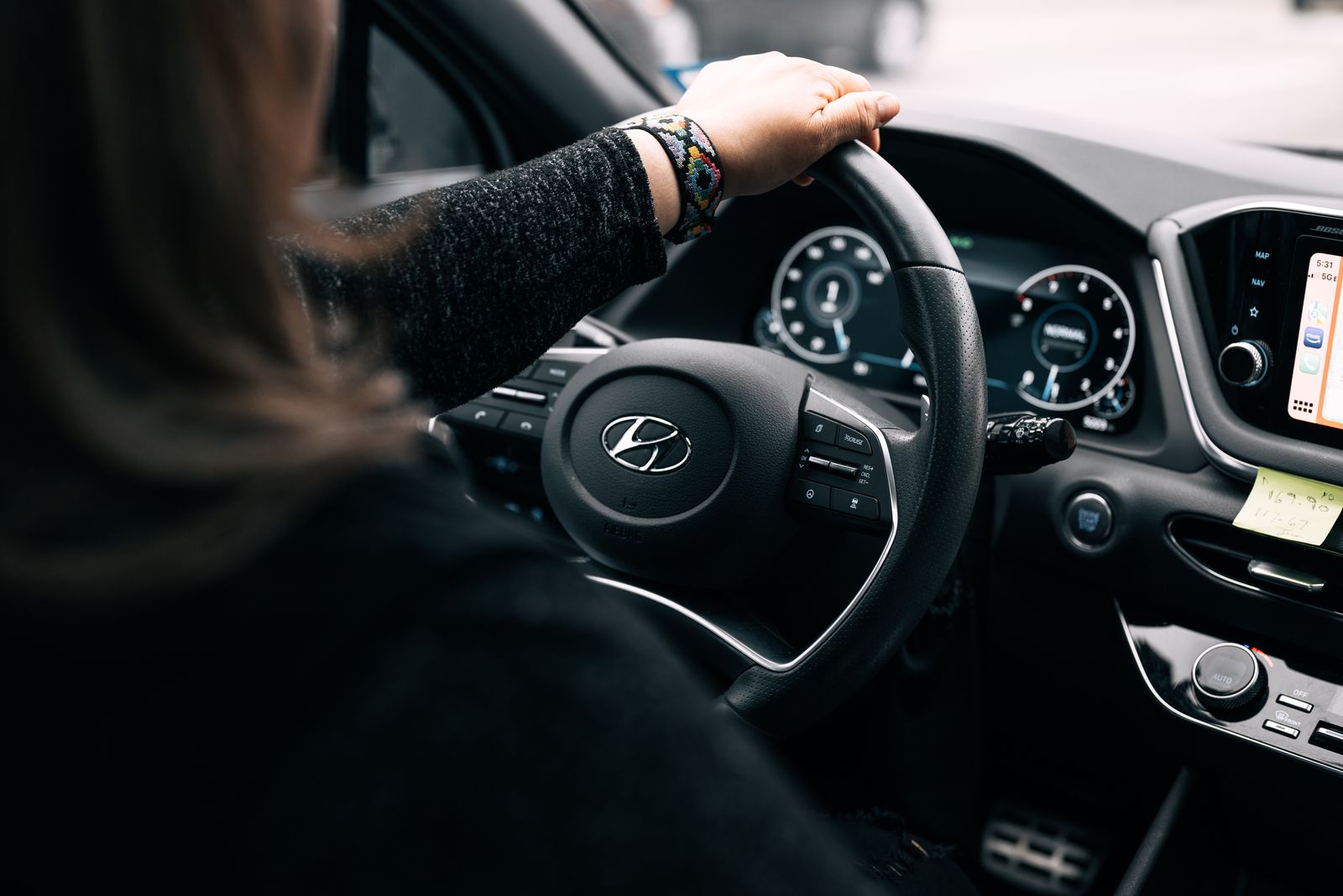
Somebody at the shop takes her own car to run the deposit to the bank and rear-ends a truck on the way. Whose insurance answers is decided by a row of numbers most business owners have never looked at. A business auto policy doesn’t list “cars” — it lists covered auto designation symbols, and the symbols printed next to each coverage on the declarations page control what that coverage is even looking at. Employee-owned vehicles used on business errands live under symbol 9. If symbol 9 isn’t there, that coverage isn’t looking at her car.
The symbols, in plain English
Two of them do most of the work here, and the standard ISO business auto form defines them narrowly (Big “I” Virtual University):
Symbol 8 — hired autos. Autos the business leases, hires, rents or borrows. The form then carves something out that surprises people: it does not include an auto borrowed from an employee, a partner, an LLC member, or anybody in their households.
Symbol 9 — non-owned autos. Autos the business does not own, lease, hire, rent or borrow, that get used in connection with the business. This is the one that reaches employee-owned cars, and only while they’re being used for the business.
So the two symbols that sound like they overlap actually don’t. Symbol 8 deliberately excludes the exact vehicles symbol 9 was written for.
There’s also symbol 1 — any auto, which is the broadest designation on the form. A policy carrying symbol 1 for liability isn’t asking these questions in the first place.
The distinction people trip on
Hiring a company is not the same as hiring an auto. If a general contractor brings in a dump truck outfit and the outfit shows up with its own truck and its own driver, that isn’t a hired auto — the contractor never leased or borrowed anything. Big “I” faculty put it directly: that exposure sits with symbol 9, not symbol 8.
It matters because the two get talked about as one thing. “Hired and non-owned” gets said so fast in this business that it starts sounding like a single coverage. It’s two, and a policy can easily have one without the other.
One more mechanic worth knowing: hired auto coverage is generally written as excess over whatever valid and collectible insurance the vehicle’s owner carries. It sits behind, not in front.
Why this comes up so much around here
Census County Business Patterns counts 398 employer establishments in Tishomingo County against 1,183 nonemployer establishments — businesses with no payroll at all. Alcorn County runs 766 and 2,704. The typical business in these counties is one or two people and whatever vehicle is in the driveway.
That’s exactly the profile where the line between “my truck” and “the business’s truck” was never drawn on purpose. It got drawn by whoever filled out the application.
The honest part
For a genuine one-person operation with no employees, nobody borrowing anything, and no subcontractors driving on the business’s behalf, symbol 9 may be solving a problem that doesn’t exist. We’re not going to pretend otherwise to add a line to a policy.
And there’s a step that comes before the commercial conversation: personal auto policies contain their own provisions about business use, and they aren’t uniform. Some are more accommodating than owners assume, some much less. Reading that section first sometimes answers the whole question, and sometimes it’s the thing that shows why the commercial side is needed.
Where to look on your own
Pull the declarations page of the business auto policy. Find the liability line. Look at the symbols printed beside it. If you see a 1, that’s the broad one. If you see 2, 8 and 9, that’s a different structure. If you see 2 by itself, the policy is looking only at autos the business owns.
Then ask whether anybody — an employee, a spouse, a subcontractor, a friend helping on a Saturday — ever drives for the business in something that isn’t on that list. Policies vary on all of this more than people expect, and the declarations page is the thing that answers it for your business, not a general article.
If you want somebody to read the symbols and tell you plainly what’s on and what’s off, bring the whole policy to the Tupelo office, or call or text 662-454-7831. Our business insurance page lists what else we work on for small operations.
This article is general information about how coverage typically works, not advice about your specific situation. Your policy is the contract, and it’s the only thing that says what you have. If you’d like someone to read it with you, that’s what we’re here for.