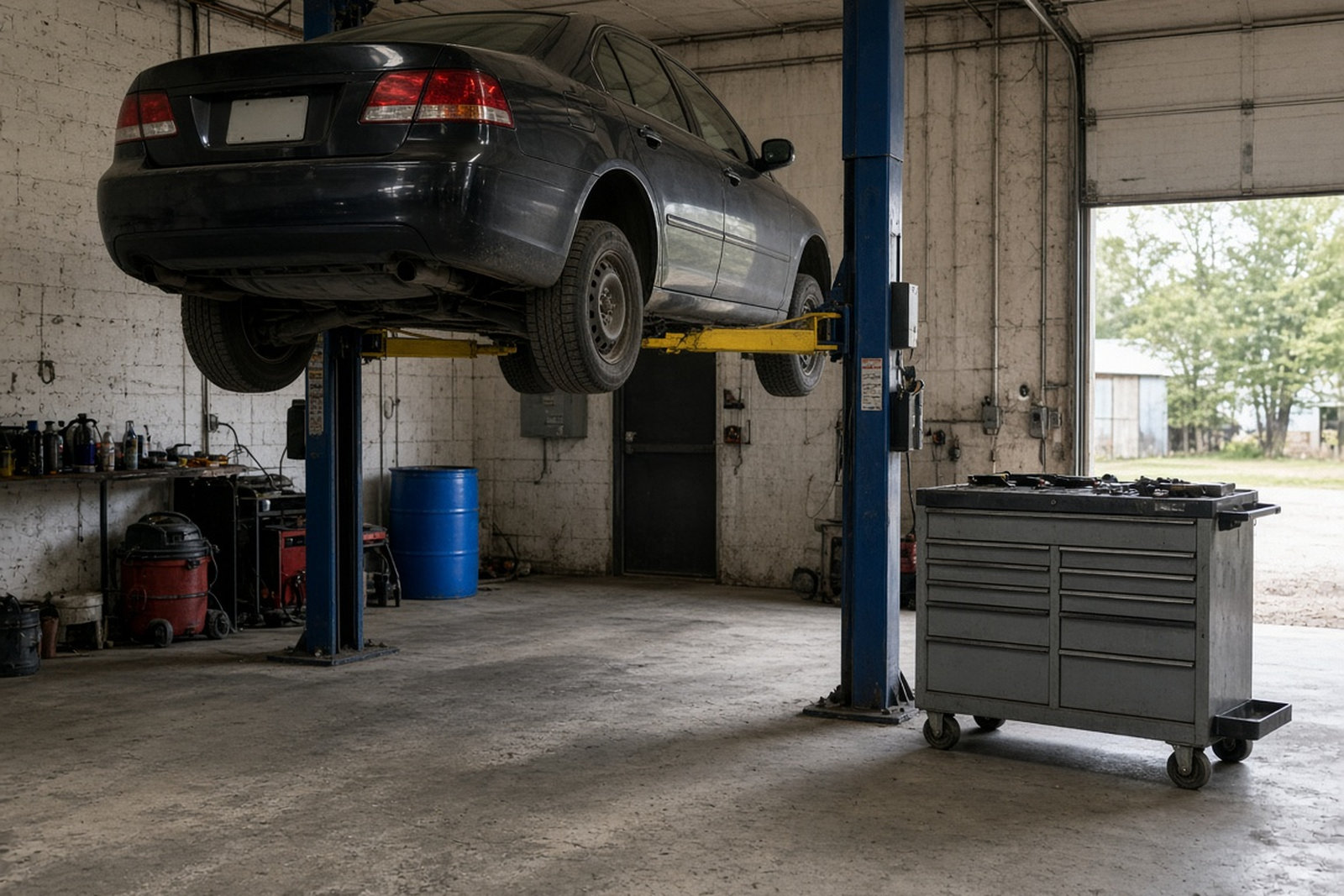
When a customer’s car is damaged while it’s at your repair shop, a standard general liability policy often isn’t the policy that pays. Most general liability forms exclude damage to property in your “care, custody, or control,” and a car on your lift is exactly that. The coverage built for this is called garagekeepers, and it’s separate from both general liability and garage liability. Without it, the claim may land on the customer’s own auto policy, or on you.
This is one of the most common gaps we see in small shops around Belmont and the rest of northeast Mississippi, and it usually turns up at the worst moment.
Three different policies, three different jobs
The names are confusingly close, so here’s the plain version.
General liability handles injuries and property damage you cause to other people in the course of business. A customer trips over an air hose in the waiting area. A tire you mounted comes off and damages someone else’s fence. What it usually doesn’t handle is damage to property you’re holding for someone, which is the whole business of a repair shop.
Garage liability is a liability form written for auto service and dealer operations. It addresses many of the same injury and property damage situations as general liability, tailored to a shop, and it can include liability for operating customer vehicles. It still generally isn’t the coverage for damage to the customer’s car itself.
Garagekeepers coverage is that coverage. It applies to customers’ vehicles while they’re left with you for service, repair, parking, or storage. It’s usually written in one of three ways:
- Legal liability. Pays only if you’re legally responsible for the damage. If a storm drops a tree on a customer’s truck and nobody at your shop did anything wrong, it may not pay at all.
- Direct, excess. Pays regardless of fault, but after the customer’s own auto coverage responds.
- Direct, primary. Pays regardless of fault, first, without sending the customer to their own insurer.
Which one fits depends on how many cars you hold, how long, and how you want customer conversations to go after a loss.
Why Mississippi’s lien law adds to the exposure
Mississippi Code § 85-7-107 gives a shop that repairs a vehicle at the owner’s request the right to keep possession until the bill is paid. If it goes unpaid for 30 days, the shop can send notice by certified mail to the owner and any lienholder, and if the debt isn’t paid within 5 days after that, it can proceed toward a sale through the courts.
That right protects your invoice. It also means a car you’re holding for nonpayment can sit on your lot for a month or more, through every hailstorm and every night someone tries the door handles. Cars waiting on parts do the same thing. The longer customer cars stay on your property, the more garagekeepers matters.
The scenarios worth walking through
When we review a shop’s coverage, these are the ones we ask about:
- A test drive goes wrong. An employee test-driving a customer’s car after a brake job is in a wreck. Damage to the other car is a liability question. Damage to the customer’s car is a garagekeepers question.
- Theft from the lot overnight. Some versions respond, some depend on fault, and some have limits per vehicle that are lower than what’s parked out back.
- A fire in the building. One fire can damage the building, your tools, and six customer cars at once. Those are three different coverages, and the customer cars aren’t in your property policy.
- Faulty work. Damage caused by the repair itself, like an engine that fails after a botched oil change, is often treated differently from damage caused while the car sits with you. Policies vary here.
The honest part
If you run a one-bay operation and cars rarely stay overnight, the legal-liability version may be all you ever need, and the customer’s own comprehensive coverage handles a lot of storm losses on its own. Not every shop needs the broadest form. What every shop should know is which form it has and what the per-vehicle and per-location limits are. Most owners we talk to have never looked.
Your policy is the thing that answers this, and the declarations page usually tells you in one line.
Let’s look at it together
If you run a repair shop, tire shop, detail business, or body shop and want to know where the customer car sits in your coverage, start with our business insurance page or request a quote. Call or text 662-454-7831 and bring your declarations page by our Belmont office. It’s a short conversation that tends to answer a long list of questions.
This article is general information about how coverage typically works, not advice about your specific situation. Your policy is the contract, and it’s the only thing that says what you have. If you’d like someone to read it with you, that’s what we’re here for.